Tuesday, May 11, 2010

In between build fests


Marcus in action of demolishing a computer in his search for materials, in this case in search for a speaker

Thursday, May 6, 2010

Inspirational Bits

What we're doing in the second iteration of the Supple project is to look closer at our design material, computer technology, and how we better can come to share the possibilities and characteristics of this material with all members of a design team and this earlier in a design process. For this we are working on a method we call Inspirational Bits.

In August/September we will use the bits that we are now working on as inspiration for the design of a second supple system.

Second Build Fest

Now we have our first proper bits.

Jordi's Comparison bits and Niklas' accelerometer bit NoisyTobias


Katjas rfid twister game


and Marcus audioalization of radio

Thursday, April 29, 2010

First proper build fest for the second iteration of the Supple project

And what a start...


Jordi is trying to make us feel the difference in sensitivity between a complete hardware solution and a solution supported by software. When he is done he argues we will feel the difference between smooth and a step like movement.


Niklas had us play with an accelerometer and made us aware of how it is more suitable for fluent movements than trying to use it for more iconic gestures. By playing with it in Niklas set up we also understood more about noise and the various parameters in an accelerometer and what they can give us.


Marcus talked about interference and how he was working on a system that will let us hear, touch and physically create interference ourselves. This to make us better understand and "see" the radio waves.


Katja had translated the numbers of rfid tags into words and we got to play around with the random sentences various rfid tags could create.

We also talked about what really makes a bit inspirational and how there is a difference between inspirational bits in general and the more specific supple inspirational bits we are trying to find. But how we probably will have to find some of the more general kind too in order to find the bits that really presents the supple aspects of our materials.

Very much looking forward to next weeks build fest!

Tuesday, February 9, 2010

LEGA@Liljevalchs

LEGAn är nu igång på Liljevalchs Vårsalong. Nedan så kan du se vilka dagar som LEGAn kommer att finnas tillgänglig. Grupper av besökare kan boka LEGAn kl 11, 13, 15 samt tisdagar och torsdagar även kl 17.
Du bokar LEGAn genom att sända ett mail där du anger önskat datum och tid till jarmo@mobilelifecentre.org. Om inga bokningar finns så går det även bra att låna dem av oss på plats. Nedan ser du när LEGA finns tillgänglig och hittills bokade tider.


OBS! LEGA är en forskningsprototyp. Om det går för sig skulle vi därför vilja videofilma er när ni använder Legan för att lära oss mer om både hur ni uppfattar den och hur vi kan förbättra den. Vi skulle även vilja ställa lite frågor till er efteråt eller be er vara med på andra utvärderingsaktiviteter. Materialet kommer att användas internt i vår forskning på Mobile Life (www.mobile-life.org), ett forskningscenter som bedriver forskning kring framtidens mobila teknik och dess användning. Om ni har frågor om utvärderingen eller forskningen så kan ni kontakta projektledaren jarmo@mobilelifecentre.org.

Monday, September 7, 2009

Design days at Liljevalchs

During five days (13-14th and 24-26th) in August the project organized a design workshop at Liljevalchs art gallery. The architect of the whole workshop was Petra Sundström who did a tremendous job of putting together an interesting agenda. The workshop had two purposes. First it marked the conclusion of the projects initial efforts to educate team members about each other’s disciplines. Having previously learnt about hardware design and sensor network programming the time had now come to interaction design. Secondly it was the start of the design process for the projects first prototype, dubbed ArtSense, which is scheduled to be shown at Liljevalchs in 2010. The first two days focused on introducing various methods for design work, while the last three days had a stronger focus on developing prototype ideas for ArtSense. Over five days participants went all the way from analysing data from the studies performed during the spring to an implemented prototype that was tested by visitors to Liljevalchs. In total the workshop was extremely successful producing over 35 prototype ideas through random words, enacting 15 of those through bodystorming, refining and selecing 3 ideas using the six thinking hats method, lo-fi prototyping those using non-computational materials such as styrofoam and cardboard, and finally rapid prototyping the ideas using computational materials and evaluating the resulting systems in-situ at Liljevalchs. Throughout this process a close relationship was maintained to the intended users: visitors to Liljevalchs. Ideas and prototypes were regularly subjected to the scrutiny of visitors which helped to weed out bugs and mould ideas. Particpants also lived their own designs through excercises in method acting where they e.g. were instructed to to use prototypes in angry, happy, slow or quick ways. This was helpful in bringing forth the supple qualites of prototypes and make them available for discussion.


Another outcome of the design workshop is the beginnings of a rapid prototyping kit for supple systems. While preparing for the design days we started investigating building blocks for rapid prototyping of supple systems. Such building blocks are necessary for early testing of ideas without having to build a system from scratch. Rather than developing blocks completely from scratch we decided to start with existing hardware and software components and modify those to suit our needs. Currently the kit consists of Sentilla JCreate sensor nodes running the Contiki operating system and various Phidgets (sensors and actuators) that can be plugged into the JCreate nodes. A driver to make the Phidgets and Contiki communicate has been developed and will be added to the Contiki distribution. The kit was first used during the design days and will continue to develop over the projects life time.

Thursday, June 25, 2009

Observation studies at Liljevalchs

In August the project will start designing a supple prototype that will be used by groups of visitors to Liljevalchs, an art gallery located in Stockholm. In preparation for that task two project members, Tove Jaensson and Jakob Tholander, have conducted observation studies at the gallery. During Liljevalchs Vårsalong, an annual exhibition at the gallery, they recruited several groups that participated in the study. All groups agreed to let us record their exhibition visit using both wireless microphones and video cameras. This resulted in several hours worth of recordings that have subsequently been transcribed and analysed.
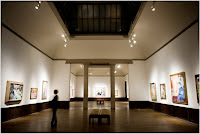

The purpose of the study is to gain some insights about what people are typically doing during a vårsalongen visit, but also to find interesting episodes in peoples exhibition visits that can serve as inspiration for design ideas. Our focus is on investigating co-experience in groups rather than the art experience itself although the two are interconnected. Issues of interest are for instance, how people come to mutual understanding of artworks, how group members direct each others attention to interesting pieces, or how they take turns looking at pieces that only allow one viewer at a time.
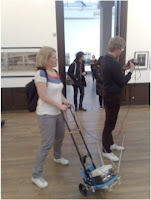
The study material will be an important inspiration and starting point for the design work that begins with a design workshop on the 13th of August. During the workshop the study will be presented but participants will also analyse some recordings on their own to learn how to do interaction analysis. This exercise is a step towards accomplishing one of the projects goals: building interdisciplinary understanding of the challenges associated with developing supple systems.